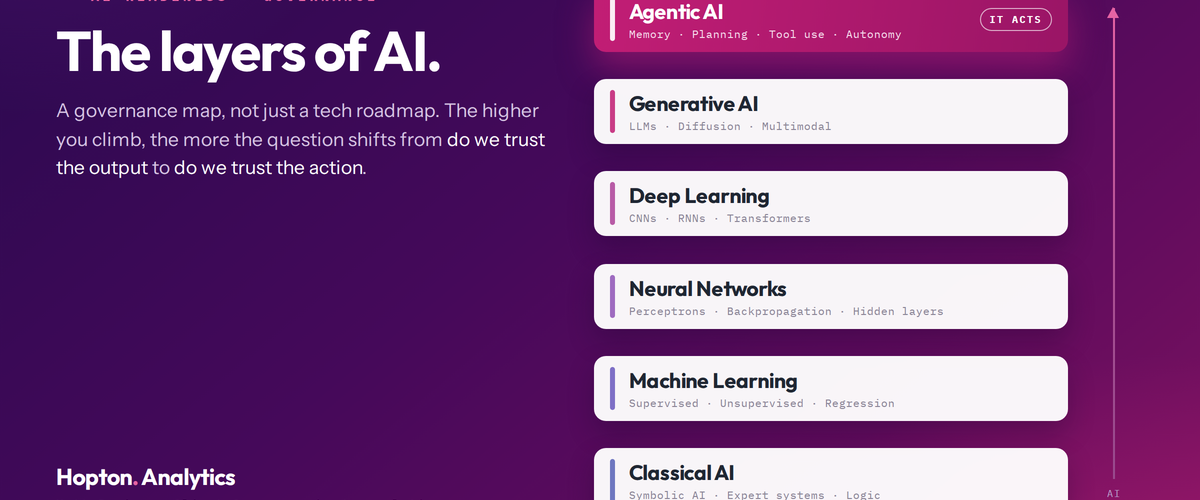
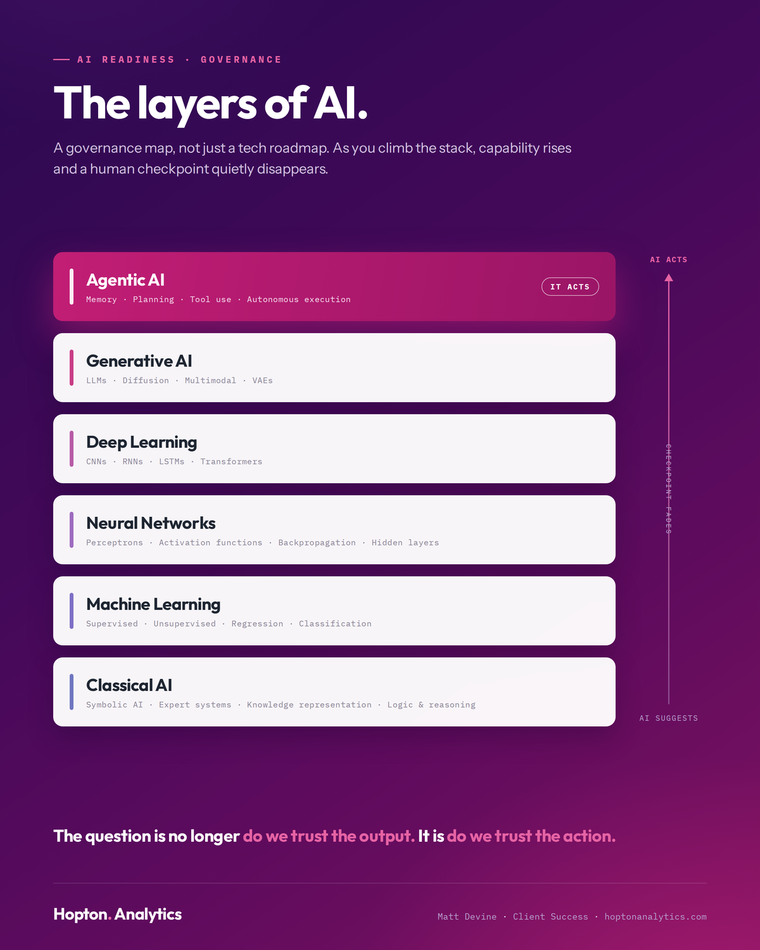
The 'layers of AI' diagrams are a useful map of how the field grew. Read as a map of accountability, they tell leaders something more urgent: as AI moves from describing to deciding and acting, control has to run the full height of the stack.
You have probably seen one of the diagrams doing the rounds that stacks the layers of AI. Classical AI and machine learning at the base, deep learning and generative AI in the middle, agentic AI at the top. As a picture of how the field has grown, it is a good one.
Read a different way, it is also a map of where a leader’s attention is about to be tested. Because the interesting thing about the stack is not the technology at each level. It is what the technology does as you climb.
What changes as you climb the layers
At the lower layers, AI describes and predicts. Classical AI and machine learning find patterns in data and tell you what they see. Deep learning does the same at greater scale and subtlety. None of it does anything to the world. It informs a decision that a person still makes.
At the generative layer, AI starts to produce. It writes, summarises, drafts and suggests. A human is usually still in the loop, reading the output and deciding what to do with it.
At the agent layer, something different happens. Agentic AI does not just suggest. It decides, acts and executes. It holds memory, makes plans, reaches for tools and carries them out. The higher you go up the stack, the less a person is present at the exact moment something happens.
That is the shift worth sitting with. It is not a bigger version of the same thing. It is a change in kind.
From accuracy to accountability
Most of the governance organisations have built was designed for AI that suggests. The central question it answers is “is the output correct”. Is the number right, is the summary faithful, is the model behaving.
Agentic AI moves the question. When a system can act on its own, the thing you need to be able to answer is not only “was it right” but “can we account for what it did”. Who approved the action. Which tools the agent was allowed to reach. What it drew from memory to decide. Whether any of it can be reconstructed afterwards, calmly, without a forensic exercise.
That is a governance problem, not a model problem. And it is not solved by making the agent cleverer.
Why governance cannot be a top layer
The temptation is to treat this as an agent-layer concern. Get the autonomous bit right, add some controls around it, and carry on. That gets the order wrong.
Every layer of the stack inherits the one beneath it. An agent plans and acts on top of generative outputs, which sit on top of models, which sit on top of data. A shaky data foundation does not become safe because you put an intelligent agent on it. It becomes more dangerous, because now something is acting on it at speed and without a person checking each step. Risk compounds upward.
So control cannot be a layer you add at the top when the agents arrive. It has to run the full height of the stack, from the data foundations to the autonomous action. This is the same principle we apply to reporting: governed from day one, not bolted on at the end. Agentic AI simply raises the stakes on getting it right.
What control across every layer actually looks like
At the foundations, it is the unglamorous work: data lineage, quality, defined metrics and access you can stand behind. Our rule of thumb is that if a system cannot cite where a conclusion came from, it has no business drawing one. That discipline matters more, not less, once something is going to act on the answer.
At the generative layer, it is grounding and provenance: knowing what the model was working from, keeping sensitive data where it belongs, and keeping a person in the loop for anything consequential.
At the agent layer, it is a specific and practical set of controls. Agents should hold their own identities rather than borrowing a person’s, so an action can always be traced to a named thing. The tools an agent can reach should be scoped tightly and no wider than the job needs. There should be limits on what it can remember and how far it is allowed to plan ahead. Anything with real consequences should pass through an approval gate. And every action should leave a complete, auditable record of what was done and why.
None of that is exotic. It is the ordinary discipline of accountability, applied to a system that can now act.
The failure modes to watch
The risks here are rarely dramatic. They are quiet, which is what makes them dangerous.
A system’s behaviour changes and nobody notices, because the change was silent rather than announced. A tool call fails, the failure is swallowed, and the plan carries on as if it had succeeded. An output is accepted and acted on because it looked confident, not because it was checked. These are the failures that erode trust slowly, and they are exactly the failures that autonomy makes faster and harder to see.
Guarding against them is not about slowing AI down. It is about making sure that when it moves quickly, you can still see what it did and why.
The question for leaders
There is a pattern that runs through every wave of technology. A new capability arrives as a convenience, something that saves you effort. Used without care, that convenience quietly becomes a dependency, something you can no longer account for or do without. Agentic AI is that pattern at its sharpest, because the convenience on offer is that the system acts for you.
The prize was always speed. The trap is letting speed outrun the controls that make it trustworthy, until you are relying on a system whose actions you cannot reconstruct. The job of leadership is not to choose between the two. It is to enable the innovation without surrendering the accountability.
Which brings it back to a simple test. If it cannot be audited, it should not act.
If you are working out where AI sits in your organisation, and how to adopt it without losing the thread of who decided what, that is a conversation worth having before the agents are switched on rather than after.
Matt Devine
Client Success Executive, Hopton Analytics
Part of the Hopton Analytics team, delivering governed analytics programmes for UK mid-market organisations.